
论文阅读20250911
题目:Containership Routing and Scheduling in Liner Shipping
作者:Qiang Meng, Shuaian Wang, Henrik Andersson, Kristian Thun
摘要
This paper reviews studies from the past 30 years that use operations research methods to tackle containership routing and scheduling problems at the strategic, tactical, and operational planning levels. These problems are first classified and summarized, with a focus on model formulations, assumptions, and algorithm design. The paper then gives an overview of studies on containership fleet size and mix, alliance strategy, and network design (at the strategic level); frequency determination, fleet deployment, speed optimization, and schedule design (at the tactical level); and container booking and routing and ship rescheduling (at the operational level). The paper further elaborates on the needs of the liner container shipping industry and notes the gap between existing academic studies and industrial practices. Research on containership routing and scheduling lags behind practice, especially in the face of the fast growth of the container shipping industry and the advancement of operations research and computer technology. The purpose of this paper is to stimulate more practically relevant research in this emerging area.
各个Level的研究现状
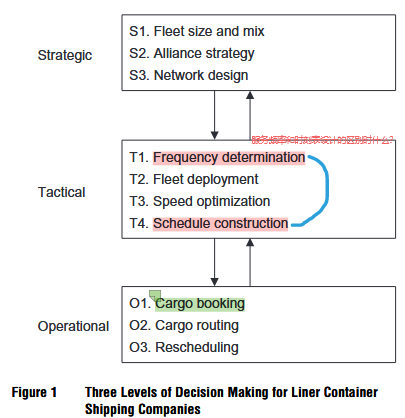
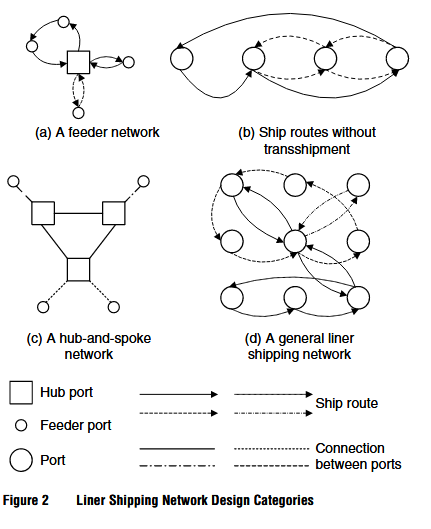
批注:战略层面的船队规模和组成问题经常和战术层面的船队部署问题放到一起研究,但很少和同时战略层面的网络设计放到一起研究,因为本身网络设计就是NP难的问题。战略层面的规划往往会覆盖30年左右的时间,这30多年会有很多不确定性,这是船队规模和组成问题的一大挑战。在班轮网络设计方面,大多数现有文献都致力于网络设计和船舶部署相结合,但假设战术层面的航行速度固定且每周服务频率固定,并且不考虑船期规划。在战术层面的服务频率决策就是决策相邻两个船舶发船的时间间隔,但在实践中很少有决策这个的,一般都是假设服务频率为1周,好处是——“The establishment of the convention of a weekly service in the industry happened for the following reasons: First, shippers like more frequent services and shipping companies wish to accumulate more cargo by providing less frequent services. A weekly service is a trade-off between the two conflicting interests. Second, a weekly service means that ships on the same ship route arrive at each port of call at the same time each week (e.g., 9:00 a.m. on a Tuesday). Consequently, container terminal operators also allocate berth time windows on a weekly basis. If a ship route does not have a weekly service, then it is difficult to allocate suitable time windows because consecutive arrivals do not occur at the same time every week.”班轮运输里面战略层面的航速优化和船期表设计实际上是一回事儿,航速对船舶的燃油消耗量有很大的影响,航速和日燃油消耗量大概是三次方的关系,因为这种非线性关系,很多研究都没有优化航速,而是将航速设置为一个预定的值,目前文献中有的绕过这种非线性性建模的方法有四种——(1)在局部用线性关系近似(2)用精确算法处理不了这种关系就用启发式算法做(3)把有不同航速的船当作不同类型的船及时他们实际上是同类船(4)使用分段线性近似。
未来研究方向
- 多式联运集装箱运输网络设计:现有集装箱班轮运输路径规划和调度只专注于海运段,而集装箱的起运地和目的地实际上很可能是在内陆地区。联合优化效果更好,内陆段运输和海运段运输的interaction在于装货港和卸货港的选择。
- 集装箱航运公司和港口运营的协同规划:For example, when a port is congested, a ship may lower its speed to save bunker because it will have to wait for a berth even if it arrives early at the port(这件事的难点在于如何预估港口预计的拥堵时间然后重新设计在航船只的航速). Another example is that the liner shipping companies and port operators will agree on berth time windows for ships over a planning horizon.
- 将网络可靠性引入班轮网络设计的模型中。
- 绿色航运
 微信
微信